

MOM is cracking down on “disguised employment” in 2026. Learn the Employee vs. Contractor test to avoid CPF penalties and jail time

There is a dangerous cost-saving tactic spreading among Singapore SMEs in 2026.
It goes like this: You hire a full-time staff member, but instead of signing an Employment Contract, you sign a “Consultancy Agreement.” You pay them a flat fee, you don’t pay CPF, and you don’t pay Skills Development Levy (SDL).
You think you are saving 17% on your wage bill. In the eyes of the Ministry of Manpower (MOM) and the CPF Board, you are likely committing CPF Avoidance and Sham Contracting.
The government is actively using data matching to find these “Phantom Contractors.” If you are caught, you don’t just pay the arrears; you face interest, fines, and potential jail time under the CPF Act.
Here is how MOM determines if your “freelancer” is actually an employee in disguise.
The Myth: “But We Signed a Contract!”
Many directors believe that if a worker signs a document saying “I am an Independent Contractor,” they are safe.
This is false.
In Singapore law, the reality of the relationship overrides the written contract. If you treat them like an employee, they are an employee, regardless of what the paper says. MOM uses specific tests to look behind the label.
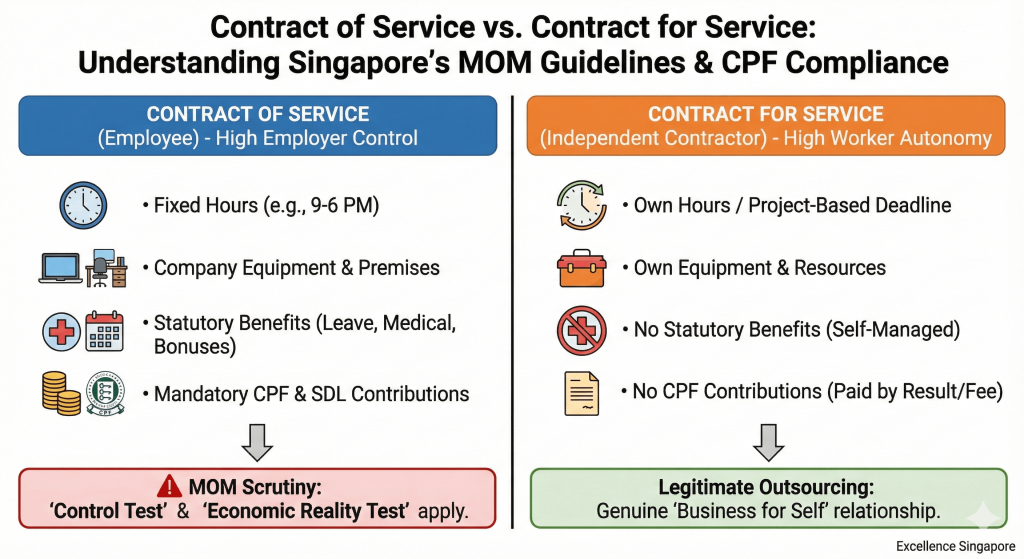
Test #1: The “Control” Factor (The Dealbreaker)
This is the single most important factor. Control refers to how much authority you have over the worker.
Ask yourself these questions:
- Who decides the hours? (Employee: You set 9-6pm. Contractor: They decide when to work.)
- Who decides the method? (Employee: You tell them how to do it. Contractor: They just deliver the result.)
- Who provides the equipment? (Employee: You provide the laptop/software. Contractor: They bring their own.)
If you require a “Consultant” to come to your office daily at 9 AM, use your computer, and report to a manager, you have failed the Control Test. They are an employee.
Test #2: The “Economic Reality” Factor
Is the worker running their own business, or are they dependent on yours?
- Profit & Loss Risk: If the project fails, does the worker lose money? An independent contractor bears financial risk. An employee gets paid a salary regardless of company profit.
- Integration: Is the worker part of your org chart? Do they have a company email address (
name@yourcompany.com) and business card? If they are “integrated” into your business, they are likely employees.
The Consequence: Section 7 of the CPF Act
When MOM reclassifies a “Contractor” as an “Employee,” the financial impact is immediate and brutal.
- Back-Payment of CPF: You must pay the employer’s share (17%) and the employee’s share (20%) for the entire duration of their employment. You cannot recover the employee’s share from them for past months.
- Interest: You will be charged late payment interest (1.5% per month) on all unpaid arrears.
- The Fine: Under the Employment Act and CPF Act, penalties for non-compliance include fines of up to $10,000 per offense and imprisonment for up to 12 months.
Unsure if your payroll is compliant? Our Payroll Services ensure you calculate CPF, SDL, and SHG correctly every month, protecting you from audit risks.
How to Do It Right: The “Contract for Service”
Legitimate outsourcing exists. You can hire freelancers, but the agreement must be a genuine Contract FOR Service.
- Focus on Deliverables, Not Time: Pay for the “Logo Design” or the “Audit Report,” not for “40 hours of work.”
- No “Employee Benefits”: Do not offer annual leave, medical reimbursement, or bonuses to contractors. These are “Badges of Employment.”
- Allow Substitution: A true contractor can send someone else to do the work. An employee must do it personally.
Conclusion: Don’t risk “Sham Contracting”
The savings on CPF are not worth the risk of an audit. If you need a full-time worker, hire them as an employee. If you need a contractor, treat them like a business partner, not a subordinate.
Do your employment contracts protect you? We draft compliant Employment Contracts and Consultancy Agreements that clearly define the relationship and pass MOM scrutiny.
Contact Excellence Singapore to review your HR compliance today.
