

Best Accounting Software for Singapore SMEs (2026)
Last Updated: March 2026
Two out of three Singapore SMEs say rising costs and shrinking margins are their biggest challenge right now (QBE SME Survey 2025). Meanwhile, 51% struggle with cash flow issues. Choosing the right accounting software won’t fix everything, but it removes one massive source of friction: compliance headaches, late invoicing, and manual data entry.
This guide compares six accounting platforms available to Singapore SMEs in 2026. We cover real SGD pricing, InvoiceNow readiness, GST compliance, and PSG grant eligibility. Whether you’re a solo freelancer or running a 50-person operation, you’ll find a clear recommendation below.
For a broader overview, see our guide on accounting compliance in Singapore.
TL;DR: For most Singapore SMEs, Xero offers the best balance of compliance features, unlimited users, and local bank integration. Budget-conscious startups should consider QuickBooks Online from S$31/month. All GST-registered businesses need InvoiceNow-ready software by 2031, with Phase 2 hitting in April 2026 (IRAS). The PSG grant covers up to 50% of costs for pre-approved solutions.
How Do the Top 6 Accounting Software Options Compare?
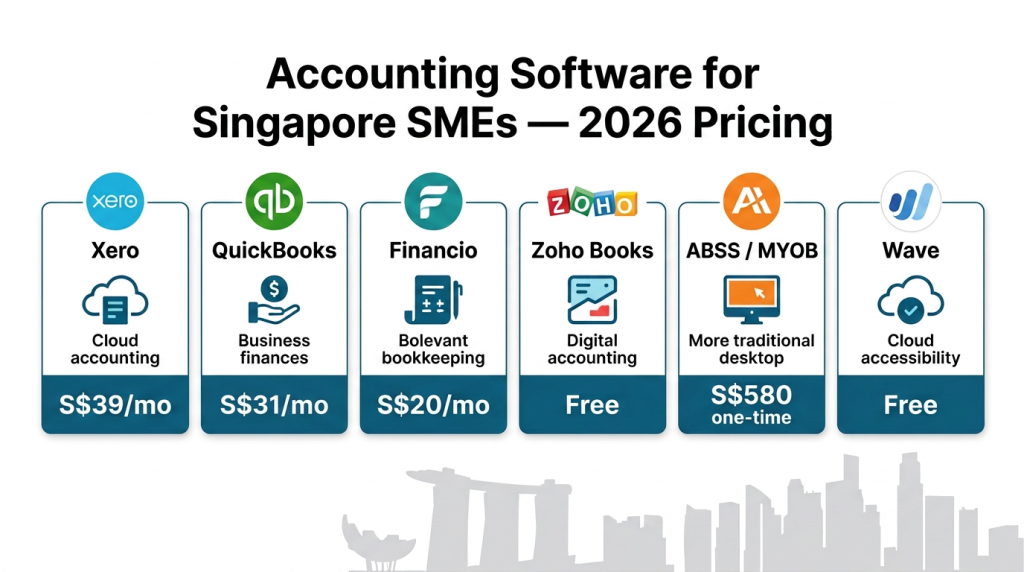
Singapore’s accounting software market is growing at a 4.2% CAGR through 2031 (Research and Markets, 2025). More options means more confusion. This table cuts through the noise with verified March 2026 pricing in Singapore dollars.
Swipe sideways to see the full table →
| Software | Starting Price | Mid Tier | Top Tier | Users | InvoiceNow Ready | PSG Eligible | GST Compliant |
|---|---|---|---|---|---|---|---|
| Xero | S$39/mo (Starter) | S$70/mo (Standard) | S$95/mo (Premium) | Unlimited | Yes | Yes | Yes |
| QuickBooks Online | S$31/mo (Simple Start) | S$57/mo (Essentials) | S$78.99/mo (Plus) | 1 / 3 / 5 | Yes | Yes | Yes |
| Financio | S$20/mo (Essentials) | S$30/mo (Premier) | — | Unlimited | Yes | Yes | Yes |
| Zoho Books | Free (<US$50K rev) | ~S$15/mo (Standard) | ~S$24/mo (Professional) | 3+ | Partial | No | Yes |
| ABSS (MYOB) | S$580 one-time | S$1,050 one-time | S$1,750 one-time | Per license | Yes | Yes | Yes |
| Wave | Free | US$16/mo (Pro) | — | Unlimited | No | No | No |
Pricing sources: Xero SG, QuickBooks SG, Financio SG, Wave, ABSS/MYOB Singapore, 361DC, Payboy. All verified March 2026.
A few things jump out immediately. Wave is free but lacks Singapore GST compliance and InvoiceNow support — a dealbreaker for any GST-registered business. ABSS is the only desktop-first option with a one-time purchase model. And Financio, at S$20/month with unlimited users, offers the lowest entry point among fully Singapore-compliant cloud platforms.
Key Takeaway: Six accounting platforms serve Singapore SMEs in 2026, with cloud subscription prices ranging from free (Zoho Books, Wave) to S$124/month (QuickBooks Advanced). The Singapore accounting software market is projected to grow at 4.2% CAGR through 2031 (Research and Markets, 2025).
1. Xero — Best Overall for Growing SMEs
Xero serves 4.6 million subscribers globally and remains the top recommendation for Singapore SMEs that need full compliance coverage. It supports GST at 9% (IRAS), InvoiceNow via Peppol, and direct bank feeds with DBS, OCBC, and UOB.
Pricing
Xero’s Starter plan at S$39/month includes unlimited users, which sets it apart from QuickBooks. The Standard plan (S$70/month) adds multi-currency and bulk reconciliation. Premium (S$95/month) unlocks project tracking and expense management. All plans include GST reporting.
Key Strengths
- Unlimited users on every plan. You won’t pay extra as your team grows.
- InvoiceNow/Peppol integration. Ready for the April 2026 Phase 2 mandate.
- Singapore bank feeds. Automatic transaction imports from DBS, OCBC, and UOB save hours each week.
- PSG grant eligible. You can offset up to 50% of the subscription cost through the Productivity Solutions Grant.
- Large ecosystem. Over 1,000 third-party app integrations.
Limitations
- Higher starting price than QuickBooks or Financio.
- Payroll is an add-on, not built in.
- The Starter plan caps invoices at 20 per month.
Who Should Choose Xero?
Growing SMEs with 5+ employees who need robust multi-user access and don’t want to worry about per-seat costs. If you’re scaling and need your accounting software to grow with you, Xero is the safest pick.
Make sure your software also supports XBRL filing requirements for ACRA annual returns.
Key Takeaway: Xero, with 4.6 million global subscribers, offers Singapore SMEs full GST compliance, InvoiceNow/Peppol support, and unlimited users from S$39/month. It integrates directly with DBS, OCBC, and UOB bank feeds and qualifies for up to 50% PSG grant funding (GoBusiness).
Need help setting up Xero for your business? Excellence Singapore provides Xero implementation, migration, and ongoing bookkeeping support for Singapore SMEs — including PSG grant application assistance.
2. QuickBooks Online — Best for Budget-Conscious Startups
QuickBooks holds 62.23% of the global SMB accounting software market (Research and Markets, 2025). Its Simple Start plan at S$31/month is a solid entry point for Singapore startups needing GST compliance.
Pricing
Simple Start (S$31/month) covers one user. Essentials (S$57/month) adds three users and bill management. Plus (S$78.99/month) supports five users and inventory tracking. An Advanced plan at S$124/month is also available for larger teams. Frequent promotional discounts (up to 50% off for the first 3 months) bring initial costs lower.
Key Strengths
- Established global platform with strong GST compliance out of the box.
- InvoiceNow ready. Supports Peppol e-invoicing for the upcoming mandates.
- Multi-currency support on all plans.
- Strong mobile app. Invoice on the go, capture receipts, check dashboards.
- PSG grant eligible.
Limitations
- User caps per plan. Scaling from 1 to 5 users means upgrading to Plus.
- Fewer local Singapore integrations compared to Xero.
- Bank feed coverage with Singapore banks isn’t as seamless as Xero’s.
Who Should Choose QuickBooks?
Solo founders and very small teams (1-3 people) who want proven, globally-recognised accounting software. If you’re comparing Xero vs QuickBooks for Singapore specifically, QuickBooks offers a lower starting price (S$31 vs S$39) for a single user, while Xero wins on scalability with unlimited users on every plan.
Many SME owners we’ve spoken to start with QuickBooks and migrate to Xero once they pass 5 team members. Starting cheap and switching later is a valid strategy, though migration takes effort.
Looking for QuickBooks setup or migration support? Talk to our team — we handle QuickBooks implementation, data migration from other platforms, and PSG grant applications so you can focus on running your business.
3. Financio — Best Singapore-Built Solution
Financio is the only platform on this list built from the ground up for Singapore businesses. At S$20/month with unlimited users and native InvoiceNow/Peppol integration, it offers strong value. It’s also a DBS Start Digital partner, giving DBS business banking customers preferential access.
Pricing
Essentials costs S$20/month. Premier runs S$30/month and adds inventory management, purchase orders, and enhanced reporting. Both plans include unlimited users — rare at this price point.
Key Strengths
- Singapore-first design. GST, InvoiceNow, and CPF considerations are baked in, not bolted on.
- AI-powered OCR scanning. Snap a receipt, and Financio extracts the data automatically.
- WhatsApp invoice notifications. Sends payment reminders to clients via WhatsApp — useful in a market where WhatsApp is a primary business tool.
- Unlimited users at S$20/month. That’s roughly half the cost of Xero’s Starter plan.
- PSG eligible.
Limitations
- Smaller app ecosystem than Xero or QuickBooks.
- Less established globally, which means fewer third-party tutorials and community resources.
- Reporting isn’t as deep as Xero Premium.
Who Should Choose Financio?
Singapore SMEs that want a locally-designed, cost-effective solution with InvoiceNow readiness out of the box. Particularly good for businesses that rely on WhatsApp for client communication.
Financio’s combination of unlimited users, Singapore-native compliance, and S$20/month pricing makes it the strongest value proposition on this list for teams of 3-10 people who don’t need Xero’s global app ecosystem.
4. Zoho Books — Best Free Option for Micro-Businesses
Zoho Books offers a genuinely free plan for businesses earning under US$50,000 in annual revenue. It handles basic GST compliance and fits neatly into the broader Zoho ecosystem, which includes CRM, HR, and project management tools used by businesses worldwide.
Pricing
Free for businesses under US$50K revenue. Standard costs approximately S$15/month. Professional runs ~S$24/month with more automation, purchase orders, and advanced reporting.
Key Strengths
- Truly free tier. Not a trial — permanent access if you stay under the revenue threshold.
- Zoho ecosystem integration. Connect to Zoho CRM, Zoho People, Zoho Projects without third-party middleware.
- Multi-currency support. Handle international clients and suppliers easily.
- GST compliance. Generates GST F5 returns.
Limitations
- InvoiceNow support is partial. Not fully certified for Peppol e-invoicing in Singapore as of March 2026.
- Not PSG-eligible.
- Free tier is limited to 3 users and basic features.
- Interface can feel cluttered because Zoho tries to upsell its other products.
Who Should Choose Zoho Books?
Micro-businesses and early-stage startups earning under US$50K who want free, legitimate accounting software with room to grow. But if you’re GST-registered or approaching the S$1 million registration threshold, the partial InvoiceNow support is a concern.
5. ABSS (Formerly MYOB) — Best for Desktop Preference
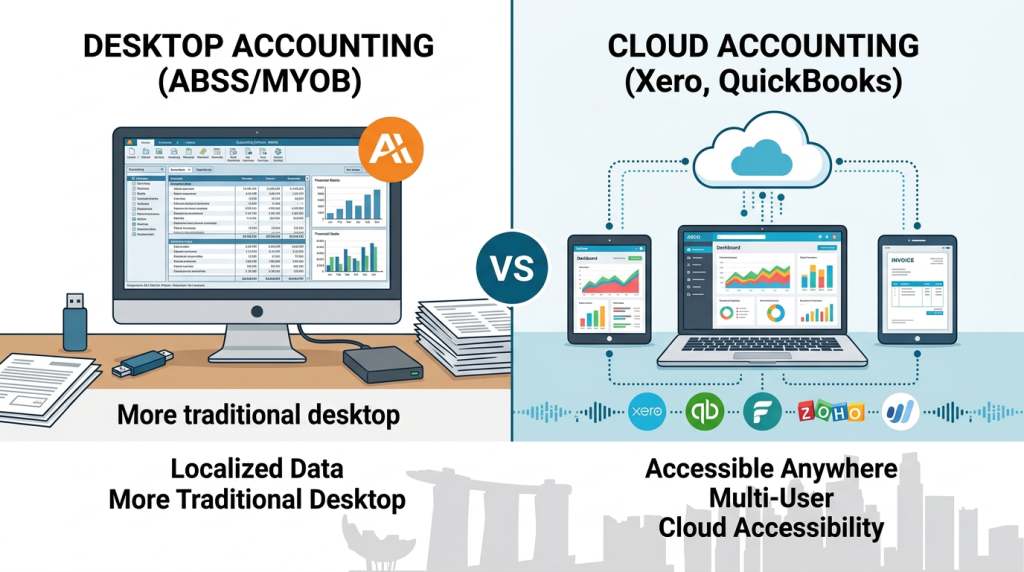
ABSS remains popular among Singapore SMEs that prefer a one-time software purchase over recurring subscriptions. Starting at S$580, it’s the most economical long-term option for businesses that plan to use the same software for 3+ years. It supports InvoiceNow via Peppol connectivity.
Pricing
ABSS uses a perpetual license model. The base package costs S$580. The mid-tier runs S$1,050. The most comprehensive version is S$1,750. Additional licenses are per-seat. Optional ABSS Connect adds cloud access.
Key Strengths
- One-time purchase. No monthly subscription. After 2 years, it’s cheaper than any cloud competitor.
- Desktop performance. Faster for large data sets than browser-based tools.
- PSG grant eligible. The 50% grant makes entry as low as S$290 effectively.
- InvoiceNow compatible via Peppol integration.
- Established in Singapore. Decades of local market presence, large accountant network familiar with the software.
Limitations
- Desktop-first means no native mobile access (ABSS Connect adds basic cloud features).
- Updates and feature releases happen slower than cloud competitors.
- Multi-user access requires additional license purchases.
- Data backup is your responsibility.
Who Should Choose ABSS?
Businesses with a single bookkeeper who works primarily from one location. Companies that dislike subscription models. SMEs whose accountants already use ABSS — switching software means switching workflows, and that’s expensive. How much does convenience matter to your team? That’s the real deciding factor here.
6. Wave — Best for Pre-Revenue Freelancers
Wave is free for core accounting, invoicing, and receipt scanning. But here’s the critical caveat: it doesn’t support Singapore’s 9% GST calculations (IRAS) and has no InvoiceNow/Peppol integration. It’s a starting point, not a long-term solution for any Singapore-registered business.
Pricing
Free for accounting, invoicing, and receipt scanning. Wave Pro costs US$16/month and adds receipt OCR, dedicated support, and bank connections. No Singapore-specific paid tier exists.
Key Strengths
- Completely free core accounting. No revenue caps like Zoho Books.
- Unlimited users.
- Double-entry bookkeeping. Proper accounting foundations, not just a spreadsheet replacement.
- Clean, simple interface. Easy to learn for non-accountants.
Limitations
- No Singapore GST compliance. This alone disqualifies it for GST-registered businesses.
- No InvoiceNow support. Can’t meet the phased mandates starting in 2025-2031.
- No PSG eligibility.
- No Singapore bank feeds.
- Limited to USD-based transactions in many features.
Who Should Choose Wave?
Pre-revenue freelancers and hobbyist businesses not yet GST-registered who need basic bookkeeping at zero cost. The moment your revenue approaches the GST threshold or you incorporate a Pte Ltd, migrate to a Singapore-compliant platform. Don’t wait until compliance deadlines force an emergency switch.
Also review these common tax mistakes SMEs make to avoid compliance pitfalls.
Which Accounting Software Fits Your Business Stage?
With 95.1% of Singapore SMEs having adopted at least one digital tool (IMDA, 2025), the question isn’t whether to go digital but which tool matches where you are right now. SME AI adoption has tripled from 4.2% to 14.5%, signalling a market that’s ready for smarter software.
Pre-Revenue / Freelancer
Pick: Wave or Zoho Books (Free). You don’t need InvoiceNow yet. Keep costs at zero. Learn proper double-entry bookkeeping habits early. Switch when you register for GST.
Early Startup (1-3 people, <S$500K revenue)
Pick: QuickBooks Online Simple Start or Financio Essentials. Both handle GST compliance. QuickBooks (S$31/month) has broader global recognition; Financio (S$20/month) has Singapore-specific features and unlimited users at a lower price.
Growing SME (5-20 people, S$500K-5M revenue)
Pick: Xero Standard or Premium. Unlimited users matter at this stage. Bank feeds with DBS/OCBC/UOB save significant time. InvoiceNow readiness isn’t optional — Phase 2 starts April 2026 (IRAS).
Established SME (20+ people, desktop preference)
Pick: ABSS mid-tier or top-tier. If your accountant already uses ABSS and your workflows are set, switching to cloud software creates disruption without proportional benefit. Add ABSS Connect for basic remote access.
Based on patterns we’ve observed across Singapore SME clients, businesses that switch accounting software during rapid growth (crossing the S$1M revenue mark) experience 2-4 weeks of productivity loss during migration. Plan your software choice to last at least 3 years.
What Must Your Accounting Software Handle for Singapore Compliance?
Singapore’s regulatory landscape is tightening. The GST rate sits at 9% since January 2024 (IRAS), InvoiceNow mandates are rolling out in phases, and ACRA’s updated BizFinx PrepTool must be adopted by 15 April 2026 (ACRA). Your software needs to keep up.
GST 9% Calculations
Every invoice, credit note, and purchase record must apply the correct 9% rate. Your software should auto-calculate GST, generate GST F5 returns, and handle mixed-supply scenarios (standard-rated, zero-rated, exempt). All six platforms except Wave handle this.
Read our full GST registration guide for threshold details.
InvoiceNow / Peppol Readiness
This is the compliance item most SMEs are underprepared for. Here’s the full rollout timeline:
| Phase | Effective Date | Who Must Comply |
|---|---|---|
| Phase 1 | 1 Nov 2025 | New voluntary GST registrants (newly incorporated) |
| Phase 2 | 1 Apr 2026 | All new voluntary GST registrants |
| Phase 3 | 1 Apr 2028 | New compulsory + existing businesses up to S$200K supplies |
| Phase 4 | 1 Apr 2029 | Existing businesses up to S$1M supplies |
| Phase 5 | 1 Apr 2030 | Existing businesses up to S$4M supplies |
| Phase 6 | 1 Apr 2031 | All remaining GST-registered businesses |
Sources: IRAS, Avalara, KPMG
Phase 2 is weeks away. If you’re voluntarily registering for GST in 2026, your software must support InvoiceNow. Xero, QuickBooks, Financio, and ABSS all do. Zoho Books offers partial support. Wave doesn’t support it at all.
See our InvoiceNow preparation guide for step-by-step compliance instructions.
XBRL-Compatible Reporting
ACRA requires financial statements in XBRL format. Your accounting software should produce trial balances and financial reports that map cleanly to the BizFinx PrepTool format. Xero and QuickBooks both export in formats compatible with XBRL filing requirements. ABSS has long supported this workflow.
Singapore Bank Feed Integration
Automatic bank feeds eliminate manual data entry and reduce reconciliation errors. Xero leads here with direct connections to DBS, OCBC, and UOB. QuickBooks supports Singapore bank feeds but with occasional sync delays. Financio connects to DBS through its Start Digital partnership. ABSS requires manual import or the Connect add-on.
Key Takeaway: Singapore SMEs face a tightening compliance window: GST holds at 9% (IRAS), InvoiceNow Phase 2 takes effect 1 April 2026 (IRAS), and ACRA’s updated BizFinx PrepTool must be adopted by 15 April 2026 (ACRA).
How Can You Save Up to 50% with the PSG Grant?
The Productivity Solutions Grant (PSG) provides up to 50% funding support for pre-approved digital solutions (GoBusiness). For accounting software, this can cut your first-year costs in half. With 66% of SMEs citing cost pressures as their top challenge (QBE, 2025), this grant is worth pursuing.
Eligibility Requirements
Your business must be registered and operating in Singapore, have a minimum of 30% local shareholding, and employ no more than 200 workers or have annual revenue under S$100 million. The grant doesn’t cover all software — only pre-approved solutions listed on the GoBusiness portal.
Which Software Qualifies?
From our list, Xero, QuickBooks Online, Financio, and ABSS are PSG-eligible. Zoho Books and Wave are not. Check the GoBusiness portal for the latest pre-approved vendor packages, as the specific packages and grant amounts change periodically.
Application Process
- Identify a pre-approved package on the GoBusiness PSG page.
- Get a quotation from the vendor.
- Submit your application via the Business Grants Portal (BGP).
- Wait for approval before purchasing (buying first voids the grant).
- Implement the solution and submit your claim.
The entire process typically takes 4-8 weeks from application to approval. Don’t rush — purchasing before approval is the most common mistake.
For a deeper look at grant options, compare PSG vs EDG grants.
Key Takeaway: The PSG grant covers up to 50% of costs for pre-approved accounting software in Singapore (GoBusiness). Xero, QuickBooks Online, Financio, and ABSS all qualify. Businesses must apply and receive approval before purchasing to remain eligible.
Frequently Asked Questions
What is the best free accounting software for Singapore?
Zoho Books offers the best free plan for Singapore businesses, with GST compliance and multi-currency support for companies earning under US$50,000 annually. Wave is also free but lacks Singapore GST calculations and InvoiceNow support, making it unsuitable for GST-registered businesses. For anything beyond basic bookkeeping, expect to pay at least S$20/month for a fully compliant platform.
See our accounting compliance overview for the full regulatory picture.
Is Xero or QuickBooks Better for Singapore Businesses?
Xero wins for growing teams because every plan includes unlimited users, while QuickBooks caps users at 1, 3, or 5 depending on the plan. QuickBooks has a slightly lower starting price — its Simple Start plan costs S$31/month versus Xero’s S$39/month for a single user. Both handle GST, InvoiceNow, and PSG eligibility. Choose based on team size and budget.
Do I Need InvoiceNow-Ready Software in 2026?
Yes, if you’re a new voluntary GST registrant. Phase 2 takes effect 1 April 2026, requiring all new voluntary GST registrants to use InvoiceNow (IRAS). Even if your phase is later, choosing InvoiceNow-ready software now avoids a forced migration down the road. Xero, QuickBooks, Financio, and ABSS all support it.
Can I Claim the PSG Grant for Accounting Software?
Yes. The PSG grant covers up to 50% of costs for pre-approved accounting solutions (GoBusiness). Xero, QuickBooks, Financio, and ABSS packages appear on the approved list. You must apply and receive approval through the Business Grants Portal before making any purchase. Buying first disqualifies your claim.
Should I Outsource Accounting Instead of Using Software?
It depends on your scale. Software makes sense when you have predictable, straightforward transactions and someone on your team can manage bookkeeping. Outsourcing works better when your transactions are complex, you lack in-house accounting expertise, or you’d rather focus entirely on running the business. Many SMEs use both — software for daily bookkeeping and an external firm for tax filing, compliance, and advisory work.
Choosing the Right Software for Your SME
The best accounting software for your Singapore SME depends on three factors: your team size, your budget, and how close you are to InvoiceNow compliance deadlines. Xero remains the strongest all-around choice for growing businesses. QuickBooks and Financio offer excellent value for smaller teams. And if you’re pre-revenue, Zoho Books or Wave can keep you at zero cost until you’re ready to scale.
Whatever you choose, make sure it handles GST at 9%, supports InvoiceNow if you’re GST-registered, and qualifies for PSG funding to reduce your upfront costs. Getting this decision right now saves you from a painful software migration later.
If you’d prefer expert guidance on accounting setup, compliance, or software selection, Excellence Singapore offers accounting and advisory services tailored to local SMEs.
For the complete regulatory checklist, see our accounting compliance guide.
