

Audit-Proofing Your Budget 2026 Claims: Why IRAS Rejects 400% AI Tax Deductions

With the massive incentives introduced in Budget 2026—specifically the 400% AI Tax Deduction and the CIT Rebate Cash Payout—IRAS is expected to increase its use of data analytics to flag “unusual” or “unsupported” claims.
The question isn’t just “Can I claim it?” but “Can I defend it during an audit?” Public search data shows that many SME owners are searching for a “pre-approved list” of AI tools. The reality is more complex: eligibility depends as much on your documentation as it does on the software itself.
Here is how to audit-proof your business before the next tax season.
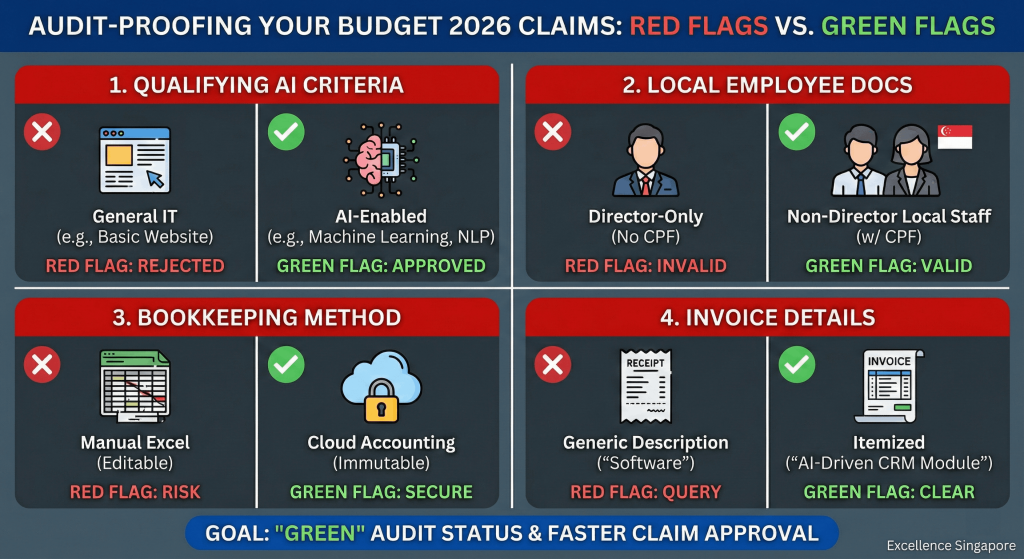
1. The “AI vs. Automation” Trap
The most common reason a 400% deduction is rejected is that the software is deemed “General IT” rather than “AI-enabled.”
- The Red Flag: Claiming a 400% deduction for a basic website or a standard accounting tool without AI modules.
- The Audit-Proof Solution: Ensure your invoice specifically identifies “AI-enabled features” (like predictive analytics, machine learning, or natural language processing). Keep a “Use Case” memo explaining how the AI actually improves your productivity.
2. Proving the “Local Employee Condition”
To get the S$1,500 minimum cash payout, you must have employed at least one local worker in 2025. This sounds simple, but reporting errors can cause a rejection.
- The Red Flag: Directors who are the only employees. Remember, shareholders who are directors are excluded from the count for this grant.
- The Audit-Proof Solution: Maintain a clean payroll register that distinguishes between director-employees and non-director local staff. Ensure your CPF contributions are made on time every single month—late payments are a major audit trigger.
3. Curing “Excel Fatigue”
Many SMEs are still using spreadsheets to track their Enterprise Innovation Scheme (EIS) spending. This is a high-risk practice for 2026. IRAS prefers records that are:
- Immutable: Records in a proper cloud accounting system cannot be easily backdated.
- Itemized: Each expense should be tagged to a specific “Qualifying Activity” (e.g., AI Literacy Training vs. General Staff Training).
4. Checklist for a “Green” Audit Status
If IRAS sends you a clarification letter, you should be able to produce these within 48 hours. Some examples include:
- [ ] Itemized Invoices: Clearly showing the vendor’s UEN and a description of the AI/Digital tool.
- [ ] Proof of Payment: Bank statements matching the invoice totals.
- [ ] SSG Course IDs: For the 400% training deduction, ensure you have specific SkillsFuture Singapore course codes and certificates.
- [ ] Employment Contracts: For the local staff member used to qualify for the cash grant.
How Excellence Singapore Protects You
An audit doesn’t just cost money in penalties; it costs weeks of your time. Our “Audit-Proofing” service ensures that every claim you make is backed by the standard of evidence IRAS expects.
- Pre-Claim Review: We audit your invoices and AI use cases before filing to ensure they meet the 400% criteria.
- Seamless Bookkeeping: We move you off spreadsheets and into a BPO-managed system that is inherently audit-ready.
- IRAS Correspondence: If you do receive a query, our tax experts handle the communication directly.
Don’t leave your tax savings to chance.
Contact Excellence Singapore for a Tax Health Check today.
