

Salary vs. Dividends: How to Pay Yourself as a Business Owner in Singapore (2025/2026 Tax Guide)

As a business owner, you have two main ways to take money out of your Private Limited Company:
-
Pay yourself a Salary.
-
Declare Dividends.
Most new directors ask: “Which one saves me more tax?”
The answer is rarely just “one or the other.” The smartest tax strategy is usually a mix of both.
In this guide, we break down the pros and cons of each method using 2025 tax rates, so you can structure your income efficiently.
Option 1: The Salary Route
Paying yourself a salary makes you an employee of your own company.
Pros:
-
Tax Deductible for Company: Your salary is a business expense. It reduces your company’s taxable profit (saving the company 17% corporate tax).
-
CPF Contributions: You build up your CPF savings for housing and medical needs.
Cons:
-
Personal Tax: You must pay Personal Income Tax (progressive rates from 0% to 24%).
-
Mandatory CPF: If you are a Singapore Citizen or PR, you must contribute to CPF (both employer and employee portions). This is a cash flow cost.
Option 2: The Dividend Route
Dividends are a distribution of the company’s “post-tax” profits to shareholders.
Pros:
-
Tax-Free for You: Singapore has a “One-Tier” tax system. Dividends are tax-exempt in your hands. You pay $0 personal tax on them.
-
No CPF: Dividends do not attract CPF contributions. You get the full cash amount.
Cons:
-
Not Deductible: The company pays dividends out of after-tax profits. The company has already paid 17% tax on this money.
-
The “Profit Rule” (Section 403): You legally cannot declare dividends if the company is making a loss. Doing so is illegal.
The “Sweet Spot” Strategy
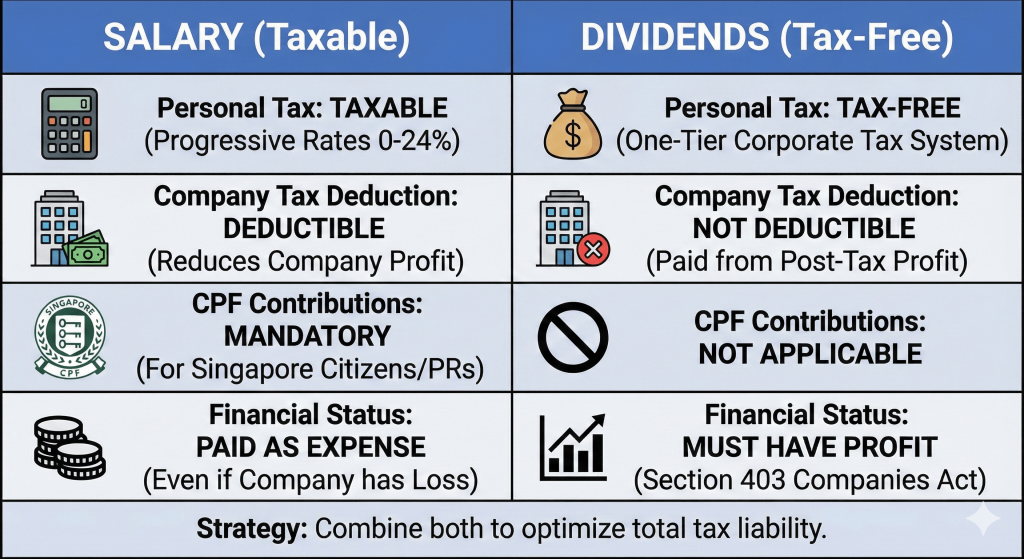
So, which is better?
-
If your company profit is low: A Salary is often better. It brings the company’s profit down to zero (no corporate tax), and your personal tax rate on the first $20,000 is 0%.
-
If your company profit is high: A Mix is best.
-
Pay yourself a modest salary (e.g., $4,000 – $6,000/month) to cover living expenses and get CPF.
-
Take the rest of the profit as Dividends to avoid the high personal tax brackets (15-24%).
-
Critical Warning: The “Illegal Dividend” Trap
We often see directors taking money out of the company bank account whenever they need cash and calling it “Dividends.”
This is dangerous. To legally pay a dividend, you must:
-
Have Distributable Profits (Retained Earnings).
-
Pass a Board Resolution declaring the dividend.
-
Issue a Dividend Voucher.
If you skip these steps, liquidators can classify those withdrawals as a “Director’s Loan,” and you may be forced to repay them if the company goes bust.
Conclusion: Don’t Guess, Calculate
Structuring your remuneration correctly can save you thousands in taxes every year. Don’t just withdraw cash randomly.
At Excellence Singapore, our Corporate Secretarial Team helps you draft the necessary Dividend Resolutions to ensure your payouts are legal, while our Tax Team advises on the optimal Salary/Dividend split.
Want to optimize your take-home pay? Engage us now.
