

ACRA Removes “Grace Period” for AGM & Annual Returns – Why Your “End of Month” Buffer is Gone

For years, Singapore company directors and secretaries relied on a simple “unwritten rule”: as long as you filed your Annual Return (AR) or held your AGM by the last day of the month, you were safe.
As of January 2026, that safety net is officially gone.
In a move to tighten compliance standards, the Accounting and Corporate Regulatory Authority (ACRA) has removed the “Front-End Grace Period” for statutory filings. This seemingly small administrative change is already triggering S$300 to S$600 penalties for unsuspecting directors.
Here is what you need to know to keep your company in good standing this year.
1. The Old Rule vs. The New Rule
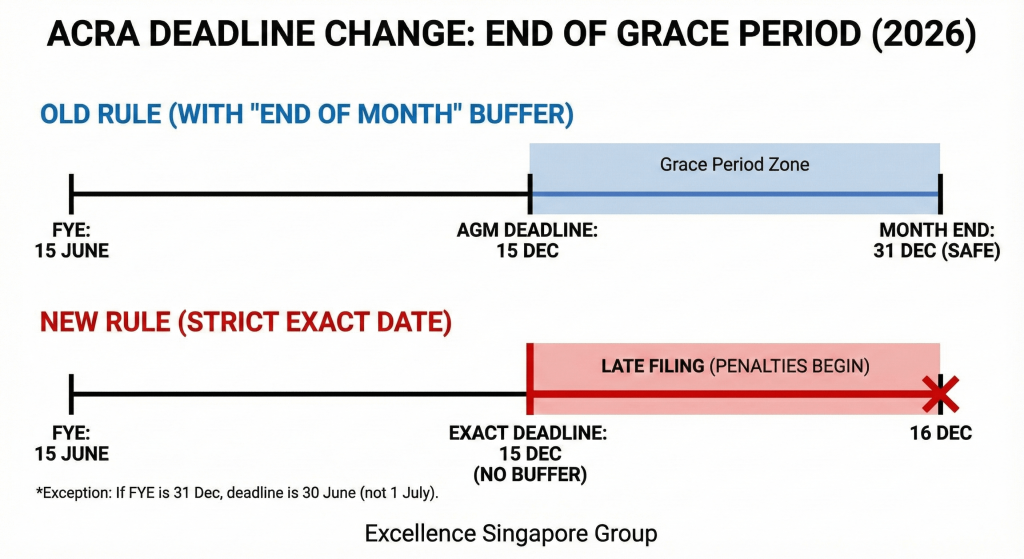
Previously, ACRA’s system often allowed a buffer. If your Financial Year End (FYE) was 15 June, your AGM deadline was technically 15 December (6 months later). However, many companies successfully filed on 31 December without penalty.
The New Reality: Deadlines are now calculated by the exact calendar date.
- Financial Year End: 15 June 2025
- AGM Deadline: 15 December 2025 (Strict)
- AR Filing Deadline: 15 January 2026 (Strict)
If you attempt to file on 16 January, you will be slapped with an immediate late filing penalty. The “End of Month” buffer no longer exists.
2. The Penalties: No More “Close Enough”
With the removal of the grace period, the penalty structure is triggered the moment the clock passes midnight on your due date.
- Late by 1 day to 3 months: S$300 per breach.
- Late by more than 3 months: S$600 per breach.
Warning for Directors: These penalties apply separately to each statutory obligation. Specifically, late filing of the Annual Return attracts a composition sum of up to S$600. Similarly, failure to hold an AGM by the due date is a separate breach that also attracts penalties. Directors should be aware that multiple breaches can result in multiple fines.
Prosecution Risk: It is not just about a S
3. The “30-Day” Exception
There is one specific scenario where the date calculation shifts slightly: If your FYE falls on the 31st of a month, but the deadline month only has 30 days.
- Example: FYE 31 December.
- AGM Deadline (6 Months): June only has 30 days.
- Official Deadline: 30 June (Not 1 July).
This is a common trap for companies with a December year-end. Do not assume you have until “early July” to sort out your paperwork. Ensure your accounting records are finalized well before this date.
4. What Should You Do Now?
If you are still managing your own ACRA filings or using a “self-service” platform, the risk of a technical breach just skyrocketed.
The Excellence SG Solution: We have already updated our internal compliance tracking systems to alert clients based on the exact statutory date, not the month-end.
- Check Your FYE: Log in to BizFile+ or ask your secretary for your exact FYE date.
- Update Your Calendar: Mark the exact day (FYE + 6 months for AGM).
- Don’t Wait: Aim to file at least 14 days early. System glitches on the final day are not a valid excuse for a waiver.
Conclusion: Compliance is Black and White
The removal of the grace period sends a clear signal: ACRA expects professional, precise corporate governance. The days of “rough estimation” are over.
Worried you might have already missed a deadline? Contact Excellence Singapore for a Compliance Health Check & Penalty Appeal Assessment.
