





















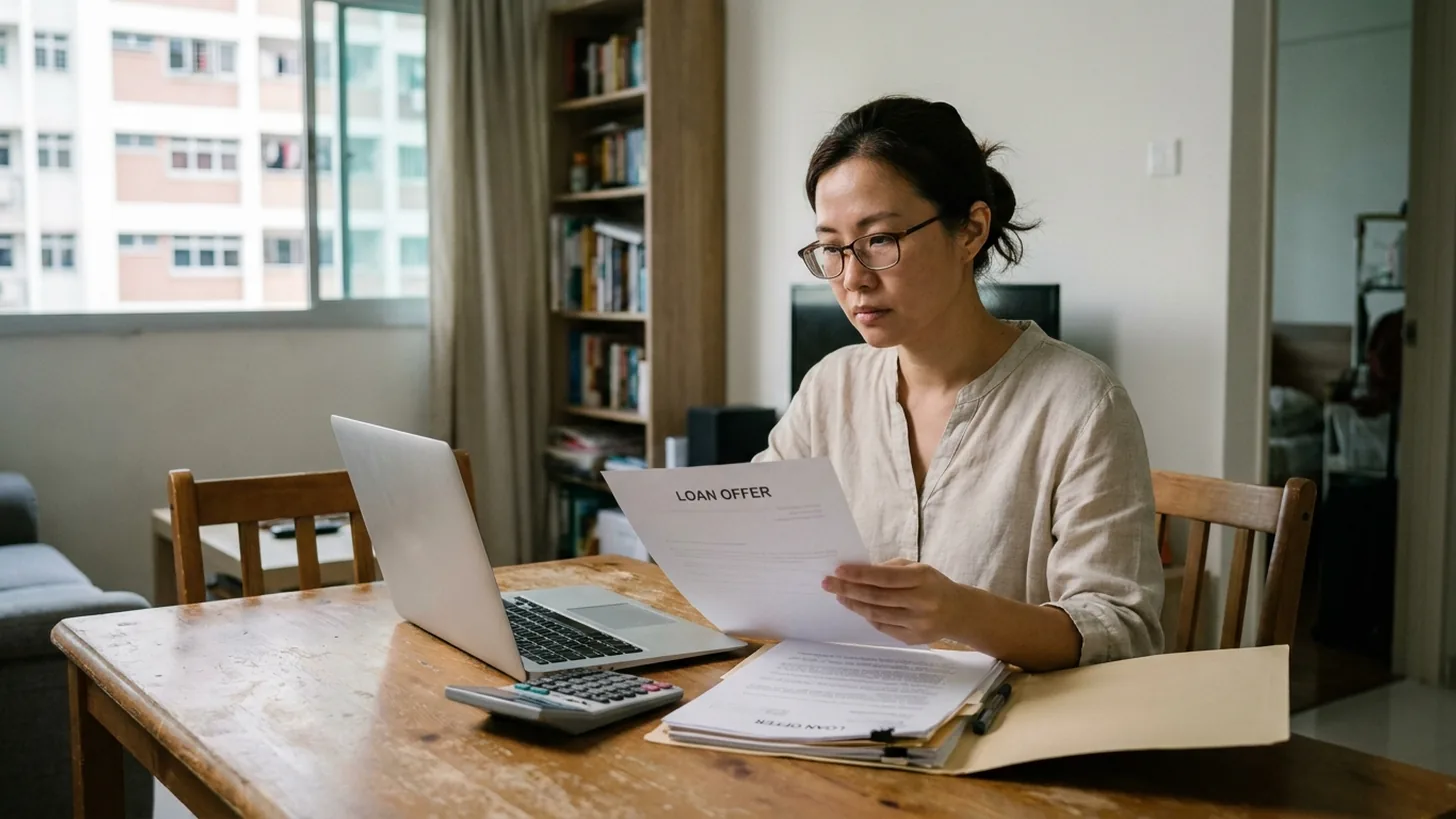
Personal instalment loans from banks: what they are and who we help
A personal instalment loan is an unsecured loan from a bank: you receive a lump sum and repay it in fixed monthly instalments over a tenure agreed at the start. Nothing is pledged as security, so the bank decides on your income and your credit record. It is what most people mean by a personal loan in Singapore. Several banks book it against an existing credit card or credit line limit, and an existing cardholder at those banks often needs no new income documents.
We are brokers, not a lender, and we are also an accounting firm. As a personal loan broker and consultant, we help Singapore Citizens and Permanent Residents obtain personal instalment loans from banks in Singapore. Most of the people we help are self-employed or run their own business, people whose income a bank usually reads from a Notice of Assessment rather than a payslip; we help salaried employees too. In every case the approval, the amount and the rate rest with the bank.
Choosing the right bank before you apply matters for two reasons. A new application usually leaves an enquiry on your credit report for 2 years, and the advertised rate is often a bank’s lowest published rate, not necessarily the rate you will be offered.
How much can you borrow? The MAS limits
A bank can grant an unsecured personal loan to a Singapore Citizen or PR only if their annual income is at least S$20,000, and below S$120,000 a year each bank’s limit is capped at 2 or 4 times monthly income. The rules are in MAS Notice 635, which applies to all banks in Singapore, and MAS summarises them in its explainer on granting unsecured credit. Banks then add criteria of their own: several set their minimum income at S$30,000.
The MAS limits by income, in one table
| Your annual income | Limit at each bank (MAS) | Limit across all lenders (MAS) |
|---|---|---|
| Below S$20,000 | No unsecured personal loan: below the MAS minimum income | The 12 times rule still applies to any existing interest-bearing unsecured debt |
| S$20,000 to below S$30,000 | Up to 2 times monthly income | Interest-bearing unsecured debt above 12 times monthly income for 3 consecutive months: no new credit, and existing facilities are suspended |
| S$30,000 to below S$120,000 | Up to 4 times monthly income | The same 12 times rule |
| S$120,000 and above, or net personal assets of at least S$2 million, or net financial assets of at least S$1 million | No MAS limit; each bank sets its own, published at up to 6 or 8 times monthly income | The 12 times suspension does not apply |
The limit at each bank covers your credit cards and unsecured loans with that bank combined. If a bank assesses your income at S$60,000 a year, S$5,000 a month, it can extend you at most S$20,000 across its cards and loans together, so a card limit you already hold there reduces what is left for a loan.
Read the detail: the 12 times rule and two related rules
The 12 times rule counts what you owe at every lender. MAS compares your total interest-bearing unsecured debt with your monthly income, and borrowers above 12 times monthly income for 3 consecutive months cannot get new credit, while their existing facilities are suspended. It counts card balances not repaid by the due date, unsecured loans that accrue interest, and interest charged on any other debt. The Association of Banks in Singapore’s FAQ on the rules adds that a 0 percent balance transfer with a processing fee counts too. A suspension lifts only after the debt falls below the limit and the bank runs fresh credit bureau and income checks, although a lender may also lift it to consolidate your debts with other lenders. For the S$60,000 earner above, the line sits at S$60,000 of interest-bearing unsecured debt.
Two related rules also apply. If your income is below S$120,000 and your unpaid interest-bearing unsecured debt is above 6 times monthly income, no bank may grant a new facility or a limit increase that takes your total limits above 12 times. If any card or unsecured loan is 60 days past due, no lender can grant you further unsecured credit until the minimum payments due are repaid and fresh checks are done.
Personal loans for the self-employed and business owners: how banks read your income
If you do not have a fixed monthly income, MAS lets a bank verify your income from your most recent Notice of Assessment from IRAS, even if the notice is more than 3 months old. Other income documents must be dated within 3 months of the application. So for sole proprietors, partners, commission earners and owners who pay themselves irregularly, the NOA is usually the key income document. Applying for a personal loan with your notice of assessment is the standard route for the self-employed, not a workaround.
Read the detail: what banks ask the self-employed for
What bank pages ask self-employed applicants to provide:
- One major bank: the latest 2 years of income tax notices of assessment, or at least the latest 1 year.
- Another: the latest 2 years’ notices, unless your NOA and CPF statement are retrieved through Myinfo with Singpass.
- A third: the latest notice of assessment.
- A fourth: the last 12 months’ CPF contribution history statement, or the latest notice of assessment.
Commission earners may have a choice: one bank accepts the latest NOA or 3 months of commission statements from the same employer.
Practical points from the accounting side.
- The most recent NOA is the one MAS lets a bank rely on. If your latest year was stronger than the year before, it pays to have that year’s return filed and its notice issued before you apply. Our guide to the notice of assessment shows how to download your latest one from myTax Portal and what to use as proof of income before it is issued.
- Have two years of notices ready, even if a bank asks for one. That is our advice: some banks ask for two years of notices and others for one, and no bank page we checked publishes how it weighs the two.
- Income is not only salary or trade profit. MAS notes that income “can include non-employment income such as rental income”.
- Keep company borrowing separate. MAS exempts loans for certain purposes from the minimum income rule, including education, medical treatment, renovation and “the business of a sole proprietor or partnership (other than a limited liability partnership) of which the borrower is the sole proprietor or a partner”. The wording covers sole proprietors and partners, excludes limited liability partnerships and does not mention company directors, so do not assume it covers a director who borrows personally to fund the company.
As accountants, this is where we start: reading your notices of assessment the way a bank will, before you apply anywhere.
What a personal loan really costs: the advertised rate vs the effective interest rate
The rate in a personal loan advertisement, the applied rate, is often a flat rate; the effective interest rate (EIR) shows the true cost, and it is the number to compare. Under the Association of Banks in Singapore’s Code of Advertising Practice for Banks, an advertisement that quotes a loan rate must show the EIR where it differs, side by side with the applied rate and with equal prominence, not hidden in fine print. The EIR must include all upfront administration and processing fees, and fees it leaves out, such as early repayment and default charges, must still be disclosed.
Read the detail: why the two rates differ, and an illustration
The two differ because a flat rate charges interest on the full amount borrowed for the whole tenure, although you repay part of the principal every month. A rate quoted on monthly rest, as one bank prices its loan, differs from the EIR only by the fees. One major bank explains that its EIR “is calculated by taking into account the declining principal balance”; another says its EIR includes “any upfront processing fee”.
An illustration, with our numbers rather than any bank’s rate. Borrow S$20,000 over 5 years at an advertised flat 3 percent a year. The interest is S$20,000 x 3% x 5 = S$3,000, so you repay S$23,000 in 60 instalments of S$383.33. Measured on the balance you actually owe, that is an EIR of about 5.6 percent. If a 1 percent processing fee is deducted from the amount paid out, the EIR rises to about 6.1 percent. Our effective interest rate calculator does this arithmetic for any offer: these figures match its reducing-balance rate, while its EIR line, which compounds the monthly rate, shows about 5.8 and 6.2 percent.
The rate you are offered is personal. Most bank pages we checked call the advertised rate their lowest published rate and say the rate you are offered depends on your credit profile and, at several banks, your income and the tenure, at the bank’s discretion. MAS does not set personal loan rates or fees; in its words, “These are commercial decisions”. Compare actual offers, not advertisements.
Read the detail: fees, early repayment and tenures
Fees, as banks publish them.
- Processing fee: 1 percent of the loan, billed with the first instalment, at one major bank; the higher of S$200 or 2 percent of the approved amount for borrowers earning S$30,000 or more, deducted before the loan is paid out, at another; none on some tenures at others. One bank instead takes a S$199 first-year annual fee from the loan amount.
- Early repayment: a flat S$250 per loan at one bank; the higher of S$150 or 3 percent of the outstanding balance at two others; 3 percent of the amount repaid, plus one month’s interest if you repay without giving a month’s notice, at another.
- Late payment: an S$80 late fee at one bank; S$100 for each month a payment is late plus daily finance charges at another, where two late payments within 6 months also add a default rate on top of the EIR.
Why early repayment saves less than you expect. Interest on these loans is front-loaded. One major bank allocates it by the “Rule of 78 method (which is also known as the sum of digits method)”; another uses a “front-end add-on” method in which “the interest component is highest in the first month and decreases gradually”. In the illustration above, 12 months is a fifth of the tenure, but under the Rule of 78 about S$1,072 of the S$3,000 interest, roughly 36 percent, falls in those 12 months. Repay then and you save about S$1,928 of interest, not S$2,400, before any early repayment fee.
Tenures. The bank personal instalment loans we reviewed run up to 60 months, five years, at most banks and up to 7 years at one, with minimum tenures of 3, 6 or 12 months; one bank limits loans of S$3,000 or less to 6, 12 or 24 months. A longer tenure lowers the instalment but adds interest, so choose the shortest tenure whose instalment you can carry comfortably.
Your credit report in Singapore: what banks see, and why fewer applications are better
Before approving a loan, a bank checks your credit report, and a new application usually leaves a record on it. Credit Bureau Singapore describes the report as “a record of your credit payment history compiled from banks and major financial institutions”. Each time a bank pulls it for a new application, an enquiry is placed on your file, and enquiries stay on the report for 2 years. The bureau lists “Too Many Enquiries” among the factors that may affect credit risk assessment, and its advice is plain: “try to limit the number of loan facilities and credit cards which you apply for.” Checking your own report does not affect your score.
Repayment history counts. In the bureau’s words, late payment on your loan accounts “will reduce your credit score”, and the score uses your last 12 months of repayment conduct.
Get your own report first. You can buy it online from Credit Bureau Singapore for S$8 before GST, logging in with Singpass. If a bank that is a member of the bureau approves or rejects an application, you can get a free report within 30 calendar days of its letter; several letters in the same 30 days still earn only one. Only the bureau and its approved members can access your report, so buying your own is the way to see what a bank checking with this bureau will see, and to raise any error with the bureau before you apply.
When a personal loan is the wrong tool
If the money is for your company, look at company borrowing first. A personal loan is sized on your personal income and counts toward your own MAS limits, which also have to cover your cards. A company can borrow on its own accounts: our business loan page sets out term loans and the government-backed schemes, and a business overdraft covers short, repeating cash flow gaps.
If you are carrying several card and loan balances, a new personal loan may be impossible once your interest-bearing debt passes 12 times monthly income. The Debt Consolidation Plan (DCP), set out by the Association of Banks in Singapore, is built for that case: it moves your interest-bearing unsecured debt with your other lenders to one participating bank or card issuer.
Read the detail: the Debt Consolidation Plan conditions
To qualify you must be a Singapore Citizen or PR, earn S$20,000 to below S$120,000 a year with net personal assets under S$2 million, and owe more than 12 times your monthly income in interest-bearing unsecured debt across all lenders. You apply to that one institution; the consolidation must be in full, the money goes straight to your other lenders rather than to you, and your other unsecured facilities are then closed or suspended. The association notes that the DCP is a commercial product, so each institution makes its own assessment.
Staying safe
Two pieces of official advice apply to any loan offer. ScamShield, the government’s anti-scam service, puts the first plainly: “Never transfer money or pay any upfront fees as a condition for receiving a loan.” In the bank terms we have seen, processing and first-year annual fees are deducted from the loan or billed with your instalments, not paid before the loan is disbursed. The second piece of advice comes from the Singapore Police Force: do not provide your “Singpass ID, Singpass password and OTP to anyone”, because stolen credentials may be used to open bank accounts for illegal transactions.
How we help
- As your loan consultant, we review your position first. Your income as a bank will read it, from your notices of assessment, CPF history or payslips; your existing card and loan limits against each bank’s MAS limit and the 12 times rule; and your own credit report. If a personal loan is not the right answer, we say so.
- We match you with banks whose criteria fit. Minimum incomes for Citizens and PRs start at S$20,000 at some banks and S$30,000 at others, one sets a higher bar for the self-employed, age limits differ, and some banks take one notice of assessment where others want two. Applying only where the published criteria fit keeps the enquiries on your credit file to a minimum.
- We compare offers on the EIR, with every fee counted: processing and annual fees, early repayment and late charges, and the tenure.
- We stay with it to the letter of offer, and go through the terms with you before you accept.
Approval always rests with the bank, and in one major bank’s words, the approved amount “can be lower than what you have requested”.
What to prepare
- Your latest income tax Notice of Assessment, and the one before it if you are self-employed or earn commission.
- Your CPF contribution history statement for the last 12 months.
- If you are an employee, your latest computerised payslips.
- Statements for your existing credit cards and loans, showing limits and balances.
- Your own Credit Bureau Singapore report.
- The amount you need, the tenure you have in mind and what the money is for.
The question to ask before you accept
Ask: what is the effective interest rate on this offer once every fee is counted, and what would it cost me to repay early? A bank prices the loan you apply for; it will not tell you that another bank’s criteria suit you better.
If you are self-employed, run a business or want a second view on a personal loan offer, send us the details and we will tell you which banks’ criteria fit, what an offer will really cost once every fee is counted, and whether a personal loan is the right tool at all. If your latest notice of assessment does not yet reflect what you earn, our personal tax team can help you get the return filed.
Personal Loan: Frequently Asked Questions
A personal instalment loan is an unsecured loan from a bank. You receive a lump sum and repay it in fixed monthly instalments over a set tenure; most bank products we reviewed run up to 60 months, and one up to 7 years. Advertisements often quote an applied rate, but the effective interest rate, which reflects the reducing balance and upfront fees, shows the true cost. Several banks book the loan against an existing credit card or credit line limit.
Yes, subject to the bank. MAS rules let a bank verify the income of a borrower without a fixed monthly income from the most recent IRAS Notice of Assessment, even if it is more than 3 months old. Some banks ask for the latest two years of notices, others the latest one, and one accepts 12 months of CPF contribution history instead. Singapore Citizens and PRs need an annual income of at least S$20,000, and some banks ask for more.
Under MAS rules, each bank can lend a Singapore Citizen or PR up to 2 times monthly income if annual income is S$20,000 to below S$30,000, and up to 4 times from S$30,000 to below S$120,000, counting that bank's cards and unsecured loans together. From S$120,000 there is no MAS limit and banks set their own. Below that, interest-bearing unsecured debt across all lenders above 12 times monthly income for 3 consecutive months stops new credit and suspends existing facilities.
An advertised flat rate charges interest on the full amount for the whole tenure, although you repay principal every month. The effective interest rate measures interest on the balance you actually owe and includes upfront processing fees, so it is higher. In our illustration, S$20,000 over 5 years at a flat 3 percent a year works out to an EIR of about 5.6 percent, or about 6.1 percent with a 1 percent processing fee.
Less than you might expect. Banks front-load the interest: one major bank uses the Rule of 78 and another a front-end add-on method, so early instalments carry more of the interest than later ones. On a 5-year loan under the Rule of 78, about 36 percent of the total interest falls in the first year. Early repayment fees come on top, for example a flat S$250, or the higher of S$150 or 3 percent of the outstanding balance.
It can. Each time a bank pulls your Credit Bureau Singapore report for a new application, an enquiry is placed on your file, and enquiries stay on the report for 2 years. The bureau lists too many enquiries among the factors that may affect credit risk assessment, and advises limiting the number of loans and credit cards you apply for. Checking your own report does not affect your score.
Buy it online from Credit Bureau Singapore for S$8 before GST, logging in with Singpass. If a bank that is a member of the bureau approves or rejects your application, you can get a free report within 30 calendar days of its letter, one per 30-day window. The report shows your enquiries, accounts, repayment history and any default records, which is the record a bank checks when it assesses you.
A bank must verify your income before it grants an unsecured loan, so expect to show some record of income. If you have no fixed monthly income, MAS lets the bank rely on your most recent Notice of Assessment, even if it is more than 3 months old. At several banks, Myinfo passes your income and CPF records through Singpass, and existing cardholders whose loan is booked against their card limit often need no new income documents.
We are a broker, not a lender, and we help Singapore Citizens and Permanent Residents obtain personal instalment loans from banks. We review your income as a bank will read it, check your existing debts against the MAS limits, and match you with banks whose published criteria fit, so you leave fewer enquiries on your credit file. We compare offers on the effective interest rate with every fee counted. Approval always rests with the bank.
Need A Hand? We Got You
